%20(8%20x%204%20in)%20(12).png)
Stretching: Understanding the Different Types.
Most people think stretching is simply "pulling on a muscle."
In reality, there are several types of stretching, each affecting the body differently and serving a unique purpose.
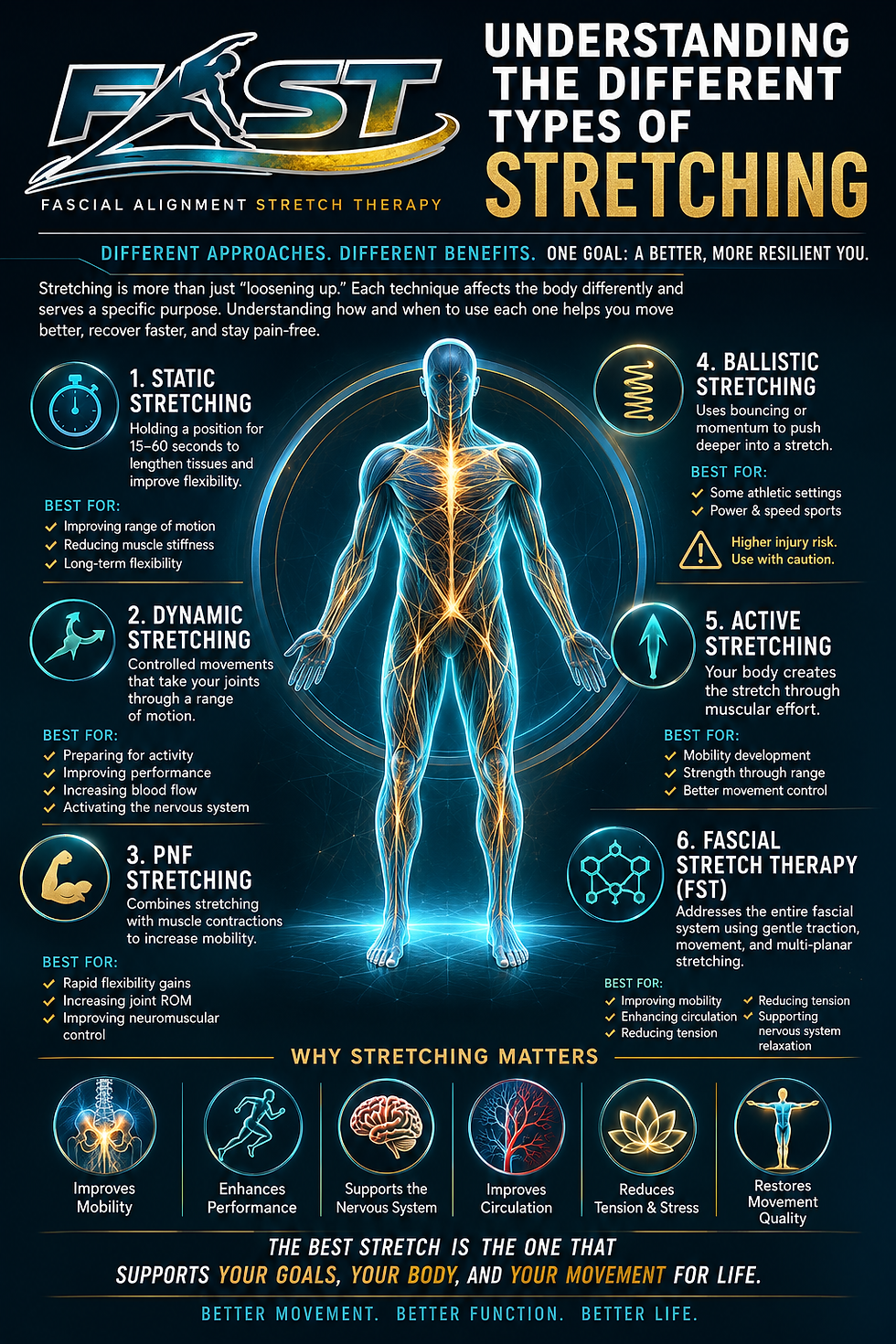
Static Stretching
This is the most familiar form of stretching. A position is held for 15–60 seconds to lengthen tissues and improve flexibility.
Supported by research for:
• Improving range of motion
• Reducing post-exercise stiffness
• Long-term flexibility gains
Dynamic Stretching
Dynamic stretching uses controlled movement through a range of motion rather than holding a position.
Examples include leg swings, arm circles, and walking lunges.
Supported by research for:
• Improving athletic performance
• Increasing body temperature
• Preparing the nervous system for activity
PNF Stretching
Proprioceptive Neuromuscular Facilitation (PNF) combines stretching with muscle contractions.
This method uses the nervous system to help increase mobility.
Supported by research for:
• Rapid flexibility improvements
• Increasing joint range of motion
Ballistic Stretching
Ballistic stretching uses bouncing or momentum to push deeper into a stretch.
While useful in some athletic settings, it carries a higher injury risk and is less commonly recommended.
Active Stretching
The body creates its own stretch through muscular effort.
Example: lifting and holding a leg without assistance.
Benefits include:
• Mobility development
• Improved strength through range
• Better neuromuscular control
Fascial Stretch Therapy (FST)
FST takes a different approach.
Rather than focusing on a single muscle, it addresses the entire fascial system—the connective tissue network that surrounds muscles, joints, nerves, and organs.
Using gentle traction, movement, and multi-planar stretching, FST works with both the fascia and nervous system.
Research supports mobility-based approaches for:
• Increasing range of motion
• Improving movement quality
• Enhancing circulation
• Supporting nervous system relaxation
The Bottom Line
The best stretching method depends on the goal.
• Dynamic stretching prepares the body for activity.
• Static stretching improves flexibility.
• PNF helps maximize range of motion.
• Active stretching develops control.
• FAST addresses how the entire body moves as an integrated system.
At FAST, we focus on helping the body move better as a whole—because lasting mobility isn't just about muscles. It's about fascia, joints, nerves, and the way everything works together.


Comments